
Agave
Types of Agave Used for Mezcal
Mezcal can be made from many species of agave, and our directory covers 40 of them. The most common is Espadín (Agave angustifolia), a cultivated agave, while others range from managed wild giants like Madrecuixe to small wild agaves at risk like Tobalá. The tables below group them so you can scan species and size at a glance.
How many types of agave are used for mezcal?
Mexico's mezcal standard, NOM-070-SCFI-2016, defines agave as any species of the genus Agave, so the list is long. Our directory covers 40 of them, and this page puts all 40 in one place. They are grouped by how our data says each agave is usually sourced, from cultivated to wild at risk.
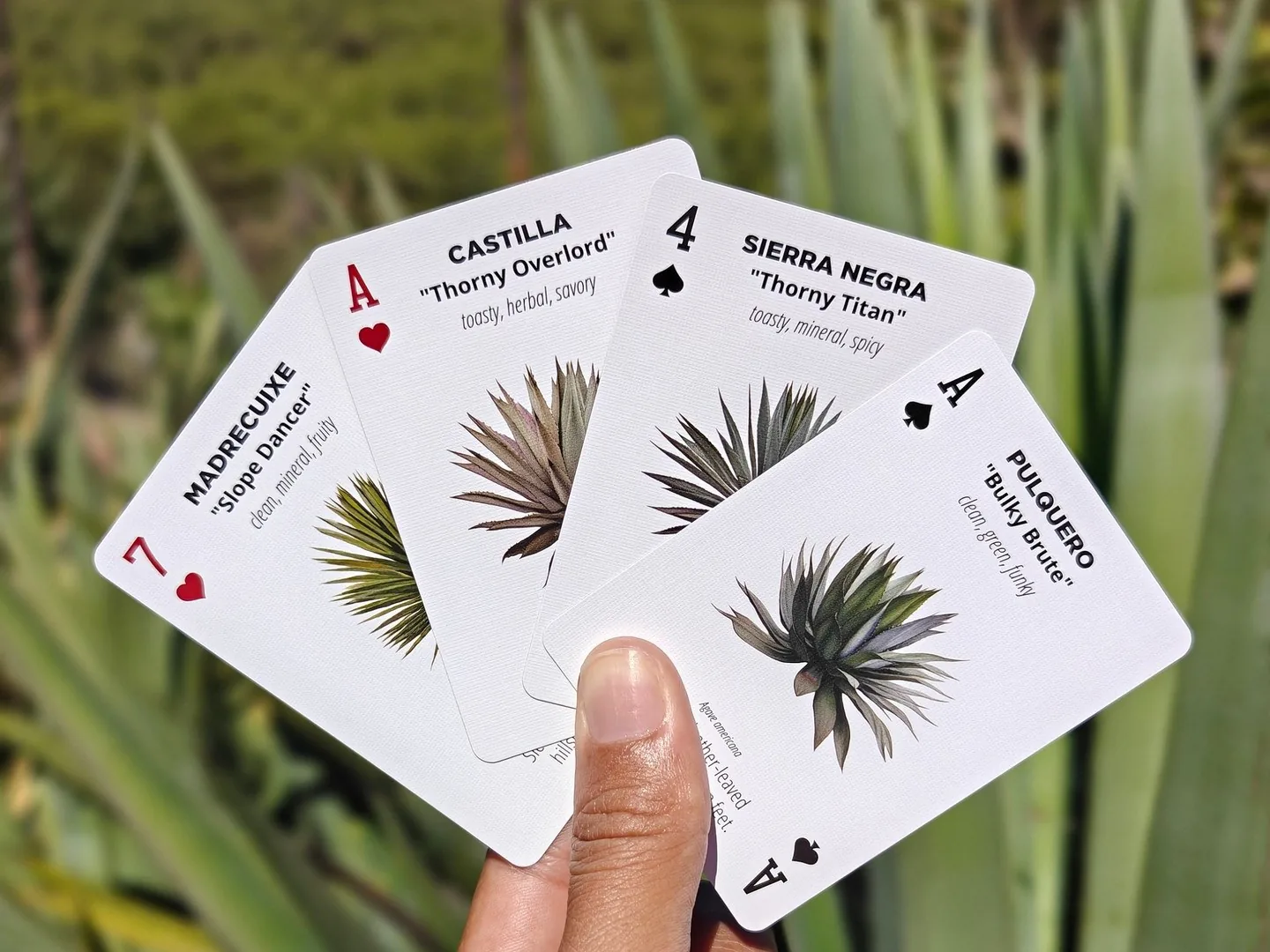
Every agave on this page also has a card in our own Discovery Deck, a card deck of 40 agaves used for mezcal.
Which agaves are cultivated?
Cultivated. Our data marks these as farmed workhorses, grown as a crop.
| Agave | Species | Size |
|---|---|---|
| Espadín | Agave angustifolia | Medium |
| Salmiana | Agave salmiana | Very large |
| Weber Azul | Agave tequilana | Large |
| Henequén | Agave fourcroydes | Very large |
| Pulquero | Agave americana | Very large |
| Pulque Chino | Agave americana | Very large |
| Cincoañero | Agave cantala | Large |
Which agaves are managed wild?
Managed wild. Our data marks these as wild agaves that people also tend or plant. The five karwinskii agaves sit here.
| Agave | Species | Size |
|---|---|---|
| Cuishe | Agave karwinskii | Very large |
| Barril | Agave karwinskii | Very large |
| Madrecuixe | Agave karwinskii | Very large |
| Bicuixe | Agave karwinskii | Very large |
| Tobaziche | Agave karwinskii | Very large |
| Lumbre | Agave sp. (unidentified) | Large |
| Arroqueño | Agave americana var. oaxacensis | Very large |
| Mexicano | Agave rhodacantha | Very large |
| Masparillo | Agave maximiliana | Medium |
| Alto | Agave inaequidens | Large |
| Manso Sahuayo | Agave americana | Large |
| Lyobaa Coyote | Agave lyobaa | Small |
| Castilla | Agave angustifolia | Large |
| Chuparrosa | Agave sp. (unidentified) | Large |
| Warash | Agave rhodacantha | Large |
| Rayo | Agave americana | Large |
| Pacífica | Agave angustifolia var. pacifica | Medium |
Which agaves are wild?
Wild. Our data marks these as wild agaves that are not flagged as at risk.
| Agave | Species | Size |
|---|---|---|
| Tepextate | Agave marmorata | Large |
| Montana | Agave montana | Medium |
| Sierra Negra | Agave americana | Large |
| Coyote | Agave americana | Large |
| Churique | Agave shrevei | Large |
| Verde | Agave gentryi | Large |
| Wocomahi | Agave wocomahi | Medium |
| Chahuiqui | Agave multifilifera | Medium |
| Cimarrón | Agave salmiana subsp. crassispina | Large |
| Lamparillo | Agave asperrima | Medium |
| Tepemete | Agave angustifolia | Medium |
Which wild agaves are at risk?
Wild at risk. Our data marks these wild agaves as at risk.
| Agave | Species | Size |
|---|---|---|
| Tobalá | Agave potatorum | Small |
| Papalote | Agave cupreata | Medium |
| Cenizo | Agave durangensis | Medium |
| Jabalí | Agave convallis | Medium |
| Espadilla | Agave angustifolia | Small |
How do you use this list?
- Check how it was cooked. If you are wary of smoke, the category on the label (ancestral, artesanal or mezcal) tells you more than the agave. Our post does all mezcal taste smoky? explains why.
- Notice shared species. Several names can share one species. Cuishe, Barril, Madrecuixe, Bicuixe and Tobaziche are all Agave karwinskii (see the karwinskii family explained).
- Order by agave name. The common name in the first column is how you will usually see it on a label or menu. Our guide to reading a mezcal label helps.
- Read up on wild agaves. How long agave takes to grow explains why wild ones are scarcer, and Mezcal vs Tequila covers why mezcal can cost more.
New to all this? Start with what is mezcal? Every agave on this page also has a card in our Discovery Deck, so you can learn them at the table.
Quick answers
- What is the most common agave used for mezcal?
- Espadín (Agave angustifolia). COMERCAM's 2026 report puts it at 84.53% of mezcal production in 2025.
- Can different agave names be the same species?
- Yes. In our directory, Cuishe, Barril, Madrecuixe, Bicuixe and Tobaziche are all Agave karwinskii. Local names often follow the shape of the plant or the region.
- Is tequila agave used for mezcal?
- Sometimes. Blue Weber agave appears in our directory as Weber Azul (Agave tequilana), and our data notes it is occasionally used in mezcal in some regions.
Meet the 40 agaves behind the bottle.