Basics
What Is Mezcal?
Mezcal is a Mexican spirit distilled from the cooked hearts of agave plants. Mexico's official standard, NOM-070-SCFI-2016, defines it as 100% agave, made from mature agave hearts that are cooked, crushed, fermented and distilled, and harvested inside a legally protected region. It can be made from many kinds of agave, which is why no two mezcals taste quite alike.
What is mezcal made from?
Agave, and only agave. The official standard, NOM-070-SCFI-2016, defines mezcal as a distilled Mexican drink that is 100% maguey or agave, made from the juices of mature, cooked agave hearts, fermented with wild or added yeasts and other microbes, and harvested within the territory protected for mezcal. Every bottle must say "100% Agave" or "100% Maguey" on its main label.
Maguey is the everyday Mexican name for agave. The heart of the plant, once the leaves are cut away, is called the piña because it looks a little like a giant pineapple. It is this heart that gets cooked, and the cooking is what turns its starches into the sugars that later ferment.
The standard also defines agave broadly, as any species of the genus Agave. That is where mezcal's range comes from. Our directory covers 40 of them, from the farmed Espadín to small wild plants like Tobalá.
What does the word mezcal mean?
It comes from the Nahuatl word mexcalli. The Online Nahuatl Dictionary, citing Frances Karttunen's Analytical Dictionary of Nahuatl, translates it as a drink made by cooking the heart of the maguey, and suggests it may combine metl (maguey) and ixca (to bake). In other words, the name is about cooked agave. The same dictionary notes that distillation came later, so the word is older than the spirit we drink today.
Is mezcal a type of tequila?
No. They are separate spirits with separate rules. Tequila is defined by its own standard, NOM-006-SCFI-2012, and according to the Tequila Regulatory Council it is made from one plant, the blue Weber agave, within its own protected region. Mezcal has its own standard, its own protected region and a much wider choice of plants.
The two are cousins: both start with cooked agave. Blue Weber is one of the 40 agaves in our Discovery Deck, our card deck of agaves used for mezcal, as Weber Azul, because our data notes it is occasionally used in mezcal in some regions. For the side by side, read Mezcal vs Tequila.
What are the official categories of mezcal?
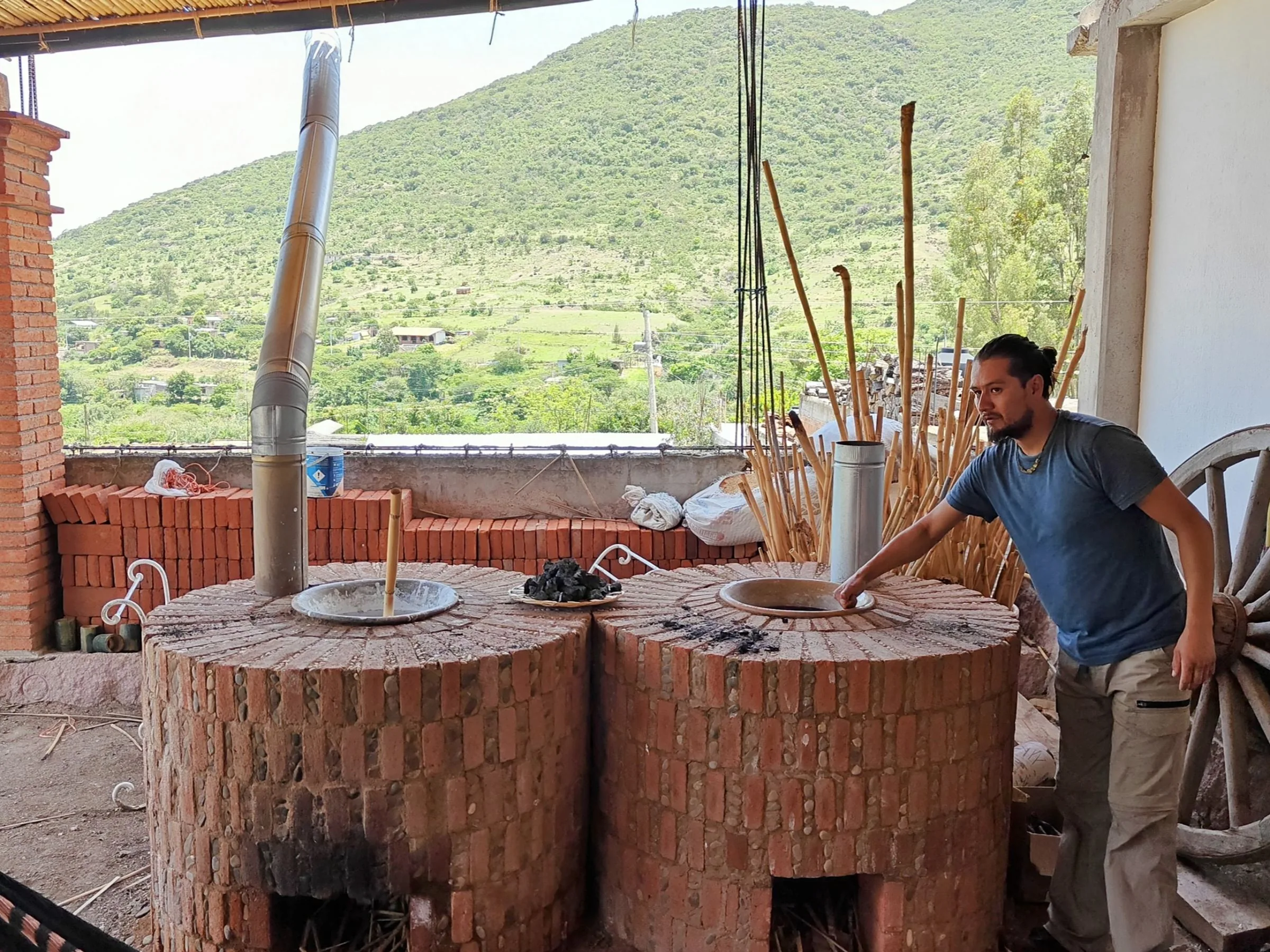
NOM-070 sets three categories, based on how the mezcal is made. Each step, from cooking to distilling, has its own allowed tools. Here is a plain English summary of sections 4.4.1 to 4.4.3.
| Category | Cooking | Crushing | Distilling |
|---|---|---|---|
| Mezcal | Pit ovens, raised masonry ovens or autoclaves (steam pressure cookers) | Includes mechanical shredders, mill trains and diffusers | Pot stills, continuous stills or columns of copper or stainless steel |
| Mezcal Artesanal | Pit ovens or raised masonry ovens | By mallet, stone wheel (tahona), mill or shredder | Over direct fire, in copper pot stills or clay pots, among others |
| Mezcal Ancestral | Pit ovens only | By mallet, stone wheel (tahona) or mill | Over direct fire, in clay pots with a clay or wood top |
Artesanal and ancestral mezcal also ferment in traditional vessels such as hollows in stone, earth or tree trunks, masonry tanks or wood. The category is printed on the label, so it tells you something real about how the bottle was made. Our post on artesanal vs ancestral mezcal goes deeper, and how to read a mezcal label shows where to find it.
The standard also lists classes, which describe what happens after distilling: Blanco or Joven, Madurado en Vidrio (rested in glass), Reposado, Añejo, Abocado con (with an added ingredient) and Destilado con (distilled with an ingredient). Mezcal must be bottled at 35 to 55% alcohol by volume.
Which agaves are used to make mezcal?
One agave does most of the work. According to COMERCAM's Informe Estadístico 2026, espadín made up 84.53% of mezcal production in 2025. Blends (ensambles) were next at 6.23%, with Cenizo at 2.00% and Tobalá at 1.78%.
The rest is a long tail of wild and semi wild agaves. Some are giants, like the karwinskii family behind Madrecuixe and Tobaziche (see the karwinskii family explained). Some are small and slow, like Papalote. Our types of agave page lists every agave in our directory in one table, and how long agave takes to grow explains why wild ones are rarer.
What does mezcal taste like?
It depends on the agave, the maker and the method, so two mezcals can taste nothing alike. Our own Discovery Deck, a card deck of 40 agaves used for mezcal, describes each agave with three flavor words, for smoke, agave character and fermentation. They are our own shorthand, not a rule. Taste is personal. Bottles vary by maker. For more, read what mezcal tastes like and does all mezcal taste smoky?
How should you drink it?
Slowly, in small pours, so you can taste the agave. Our guide to how to drink mezcal covers cups, orange slices and sal de gusano. If you want to learn the agaves as you go, our Discovery Deck puts each one on a card.
Quick answers
- Is mezcal a type of tequila?
- No. Tequila has its own standard and is made only from blue Weber agave. Mezcal has its own standard and can be made from many agave species. Both start with cooked agave.
- What does the word mezcal mean?
- It comes from the Nahuatl mexcalli, a drink made by cooking the heart of the maguey. The name may combine the words for maguey and for baking.
- Is all mezcal 100% agave?
- Yes. NOM-070-SCFI-2016 defines mezcal as 100% agave and requires "100% Agave" or "100% Maguey" on the main label.
Meet the 40 agaves behind the bottle.